My sweet daughter bought me two prints of Polonia’s historical dress that were very impressive. Images such as these were painted by the famous painter of Polish history, Jan Matejko.

My previous research told me that these people in the painting likely were not the class of Poles from which I descended. The reality of my Galician ancestors living under serfdom until 1848 in the remote villages of Poland wasn’t correctly portrayed in the finely tailored clothing of these more aristocratic or wealthy landowners. This elite class of Poles typically didn’t immigrate like my ancestors did, and why would they? Life was quite lovely for the landowners. Now, if I had a photo or painting of my ancestors from the 1800s, what would they look like?
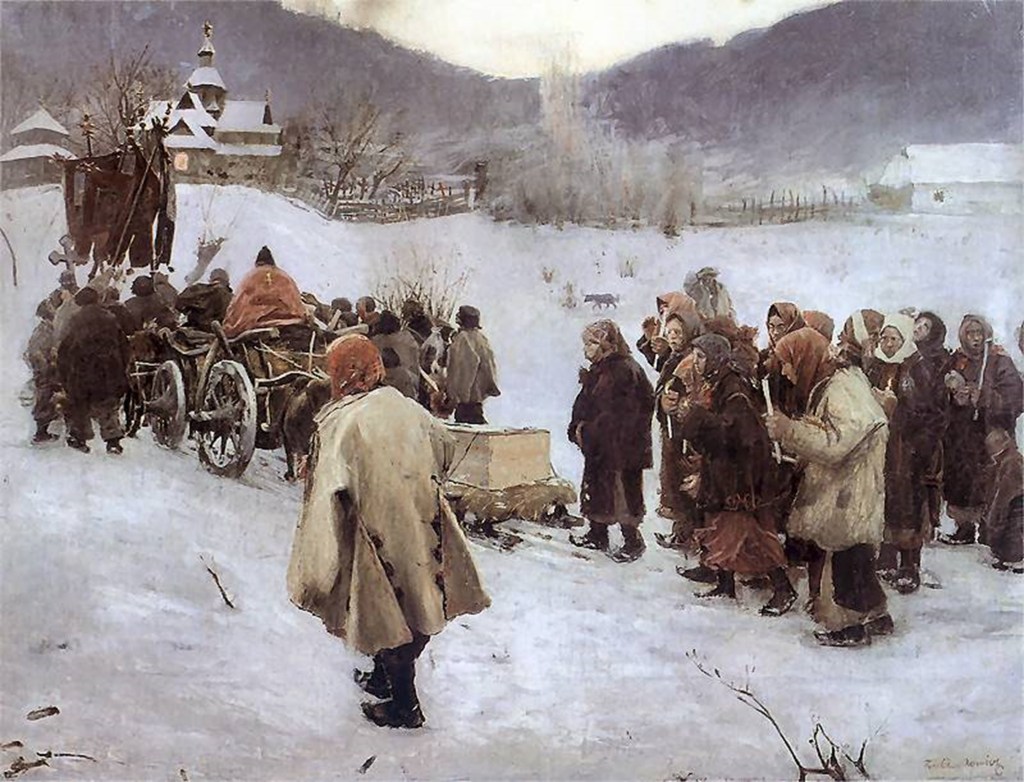
An article written for the Pittsburgh Dispatch in 1892 describes the two different worlds the visitor discovered in what was then Galicia in the Austrian Hungarian Empire. The author of “Wakeman’s Travels,” assumed to be Mr. Wakeman, was visiting the new petroleum fields of Austria. Describing the oil fields that were dug by hand as primitive, he noted that the Polish and Ruthenian peasants earned about 36 cents each day in the oil industry. In addition, they were given a daily allowance of cordwood for their fuel. That was far more than the average Pole in the villages of Galicia, who earned about twelve cents each day.

Peasant clothing 1507-1548
Wakeman also went to Galicia “to study the lowly” in their “purely peasant villages.” Of course, he was a guest at several manor houses of noblemen and gentlemen farmers, so Wakeman saw the people through their employers’ points of view. His condescending description of the laboring peasantry of the villages and those who served at the homes of the gentry reflects the arrogance of many from the elite and educated British class.
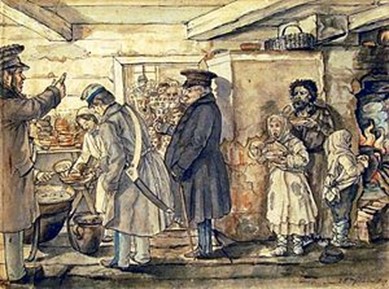
Galician Poles near Sanok around 1840
Wakeman describes the servants as “even more soddenly stupid and servile” than the laboring peasantry of the villages. Their physical appearance also doesn’t impress the author, saying,
“He is a curious-looking fellow. His hair is cut either straight across his forehead, or to a spear-like point upon it, and grows like a lion’s man about his shoulders and neck.
Dressed like Robinson Crusoe
His head covering is a mangy fur hood, often of squirrel skill with the tail dangling loosely upon his shoulder, or of sheep or goatskin with the fleece side next his head. A sort of greatcoat or robe hangs loosely from his shoulder to below his knees. This is of the skin of some animal, with the fur or hair next the body. The reversed exposed side is covered with ancient layers of grease for protection against the snow and rain. If he possesses undergarments of any sort, they are shreds of rags stuffed with chaff and straw.

Peasant costume by Jan Matejko 1548 – 1572
He usually wears stockings of the heaviest and coarsest material, and high-legged pointed shoes of huge proportions. For not only are the precious hose protected by ropes of straw wound from above the knee to the ankle, but enough chaff and wisps of straw participate in occupancy of his cavernous shoes to provide sufficient warmth. Aside from this unique garb, his beard stands out from his face a massy, wiry chevaux-de-frise (a wooden defense with protruding sticks), in which enough straw and chaff have lodged to provide an adequate “comforter” for his face and neck.”
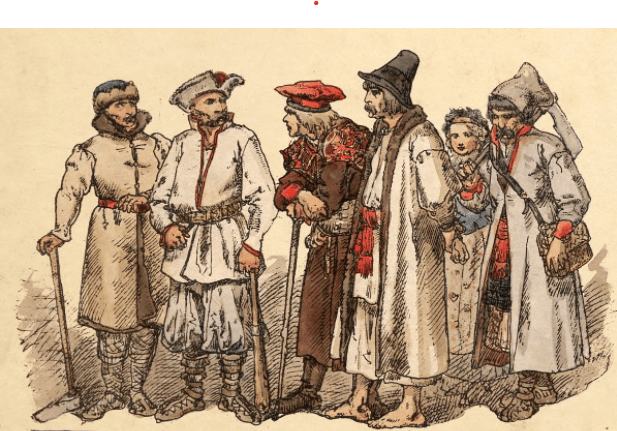
Wakeman described the Ruthenian woman as having “some odd ideas of dress.”
“The material is usually of coarse linen. Her gown, which is in reality her chemise, is open from neck to knees and is belted in loose folds about the waist. Another curious and distinguishing article of dress is her woolen apron. She is never without this, but it is worn behind, never in front. She has no stockings or undergarments but her feet are shod like her husband’s- with pointed and laced moccasins. Her head in winter and summer is always bound in a gaudy handkerchief, but she possesses no other article of clothing whatever, except a sheepskin coat for winter use. What she lacks next her skin she makes up in ornamentation. I have counted more than a score of brass ring on the fingers of her two hands. Her earrings of hollow brass would hold enough oil to light the family fireside for an evening; and her necklace of glass or imitation coral beads, coiled a half dozen times about her by no means charming neck, is always yards in length.“
Wakeman, to his credit, was shocked that the peasant servants in Poland were treated so poorly.
“Whenever my host and I moved about the estates, these white slaves first bent and kissed the hems of our great coats and then stood with bared head in silence until we had passed. No doubt this sort of thing gives the master a grand czar-like feeling, and it is lording it cheaply besides.“
The Galician female was responsible for the arduous task of producing the coarse linen from flax for everyday clothing. Starting in October, she worked with the flax by hackling (cutting), drying, and soaking. Spinning the yarn would wait until the winter. Sewing and embroidery kept them busy once the local weaver returned the woven cloth. Although ready-made clothing could be purchased at the town markets, homespun linen was still used for bedclothes and simpler dresses.
Unmarried young women worked on their wedding garments for the years preceding marriage. If she died prematurely, the youth would be buried in that garment.
Wakefield’s comments about the lack of underwear for women appear to be true. In Peasant Maids, Christiane Harzig mentioned a recent Chicago immigrant who noted that underwear was “not popular in the Polish countryside” and remembered underwear as the first time she ever felt warm. Underwear must have been worn by some. Jan Słomka, a man who wrote one of the only books on life during and after serfdom, refers to them as smaty, “rags,” or “slip-ons.”
Jan Słomka’s important book “From Serfdom to Self-Government: Memoirs of a Polish Village Mayor, 1842-1927” details many aspects of life under and just after serfdom. His contemporaries were illiterate or certainly didn’t have the time or inclination to write such an amazing resource for historians. Słomka states (translated from Polish),
“We wore whatever clothing we could make at home. From ancient times, men’s dress in summer consisted of a shirt reaching down over the trousers to the knee, and a sleeveless vest. Women and girls also put on sleeveless vests over their shirts in the summer, or threw on a shawl; they also wore aprons of homespun.
Married women wore colored caps made from store-bought material, sometimes tying a kerchief on them, especially if the cap was old and worn. Girls went to weddings with bare heads, their hair woven in braids that fell down to their shoulders, adorned with ribbons, roses, periwinkles, and various other flowers.“

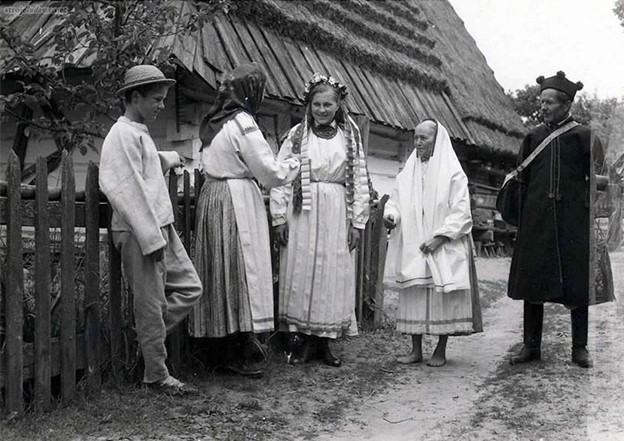
Polish women probably in the early 1900s. Note they are all barefoot.
Słomka’s observations agree with Wakemans in some respects. In all the photos and paintings, we see impoverished people who typically owned few clothing items and went barefoot in better weather. Everything in life was functional, and they purchased only essential items at the town market, stores, or from the village peddlers. Galicia was the poorest region in Europe, and what little money they had would be spent on items they couldn’t produce, such as salt and oil.
Słomka’s descriptions are closer to what we witness in historical photos. “During the winter, men wore sheepskins and vests over them for church. In many villages, the men dressed much better with their special clothing for weddings and large parades with overcoats of white cloth, like men in the big cities.
Everyone made a gallant effort to dress better for weddings than for church. The men wore white circular cloth Magyar caps on their heads, while the older and wealthier ones wore black lambskin caps trimmed with white, with a gray ribbon in the back.
Men always wore belts that were used to carry money. The older men wore wider calfskin belts. The younger farmers and unmarried men wore narrower belts called Kraków belts. Decorated with buttons and brass rings that clinked as they danced, these belts were so long they could reach around twice. A song from Krakow described these belts. ‘I’m from Kraków, you can see that about me. There are seventy rings on my belt. Seventy rings, each by itself. Count them, girl; maybe there are more.’
Boots were sown with cobbler’s thread, and boots studded with little cobbler nails became quite popular. “studded” boots, that is, with little cobbler’s nails, provoked a lot of awe among the people. Many people wore leather moccasins remade from old boot tops. The villagers who lived near forests wore clogs usually made from linden wood bark. For everyday life, the villagers worked in older, dirty, and threadbare clothing.”

As seen in the photo from an ethnographic museum, Coral beads were the most popular jewelry to display a woman’s wealth. Women adorned the white clothing with embroideries of different colors. The nicest and most popular designs earned the village seamstresses steady work. Colorful ribbons and braids also decorated the clothes of both genders.
After serfdom ended, the people began to dress in white in summer and winter and on holy days and regular workdays. The more prosperous woman displayed her wealth with colorful skirts and store-bought vests.
In the decades after serfdom, the villagers bought more clothing or fabric from stores in town. The Jewish retailers provided an ever-increasing variety of items to satisfy the tastes and preferences of the wealthier locals. It became fashionable for women to wear five or six skirts with the nicest worn on top. To appear broad and stout was a way women displayed they were fashionable. Then, the fashion trends dictated that women should try to have tiny waists, so they began to lace up.
Women’s hats, similar to a bishop’s miter, were made of cardboard trimmed with colorful materials and gained popularity. The milliners took orders at the town fairs or in front of the churches on Sundays.
Laundry was usually done weekly because linen was scarce, and it was typically changed on Sunday morning to dress well for church. Linen and rags were soaked in large tubs on the night before laundry day. After a first washing in the pond, the clothes were put in a trough on three high legs, called a tryfus. Layers of fine hardwood ash were sprinkled between the layers, and the hot lye was poured over them. The lye soaked through all the layers of linen and then ran out a hole in the bottom of the trough into a tub. This was repeated for several hours until the linen was soaked and steamed.
After being washed and then dried in the sun, the clothes had a pleasant smell. Starch was produced in the home from rye or wheat meal. Ironing was unknown, and hand mangles were used instead. A press and roller were set up in every house for this work. The clothes for church and holidays were folded after pressing and put up in wooden chests.
Wakeman’s observations of the peasants just forty-four years after the end of serfdom were harsh. He may not have realized that prosperity doesn’t come instantly after people gain freedom. The serfs had little experience with money before liberation. The new burden of paying taxes came with independence, something they didn’t do as serfs. They also lost the right to hunt on manor land. Then, the land that the serf was granted in 1848 no longer was sufficient. Inheriting a parent’s land meant that a meager amount had to be subdivided among siblings.
Faced with this problem and extreme poverty, the young Galicians likely were influenced by the stories from America and Canada. The impressive modern clothing worn by returning and visiting immigrants must have motivated them to move out of their homeland. We are glad that our ancestors did!
References:
Peasant Maids: City Women from the European Countryside to Urban America by Christiane Harzig
From Serfdom to Self-Government: Memoirs of a Polish Village Mayor, 1842-1927″ by Jan Słomka
Wakeman’s Travels Pittsburgh Dispatch April 30, 1892.



 Donna Gawell