From the Rynek Underground Museum in Krakow
Walking between the Cloth Hall and Saint Mary’s Church in Krakow, visitors may not realize that hidden under the ground is a treasure trove of knowledge about Kraków’s past. To discover it, you just step down into the Medieval Rynek (town square) below Cloth Hall.
The establishment of this interactive exhibition began with the archaeological study conducted from 2005 to 2010. There, researchers discovered traces of the many centuries of history. An archaeological reserve unique in Europe, covering nearly 43,000 sq. ft, was fashioned under the surface of the Rynek to provide a display for the treasures.
The Rynek Underground exhibition presents the connections between the city and medieval Europe’s chief centers of trade and culture and portrays the significance of the capital of Poland in the operation of the Hanseatic League. The historical objects on display are proof of the European cultural and trade exchange that continued here for hundreds of years. The tourist route under the Main Market Square leads between the stone and brick walls of the cellars and stalls of former trading sites, the Great Scales, and the Cloth Hall.
The exhibition shows medieval tools, historical coins, clay figures, decorations, dice, and toiletry articles used over 600 years ago, together with the Tartar arrowheads, beads, and medallions from the Orient.
Visiting the tourist route in the Rynek Underground, one can also become familiar with the history of Kraków from before the city’s foundation. A picture of the pre-charter settlement destroyed during the Tartar raid of 1241 emerges from the original foundations of cottages from the late 12th and early 13th century, as well as reconstructions of goldsmiths’ and blacksmiths’ workshops. The oldest history of the site is shown in reconstructions of 11th-century burials. The visitor will also learn about the vampire burials found during the excavations. Yes, vampires!
Visitors are immersed in Kraków’s Medieval market’s hubbub of bargaining. The exhibition is enriched with interesting models and multimedia – touchscreens, holograms, projections, and documentary films presented in the spaces of the cellars under the Cloth Hall arranged especially for that purpose.
The Book of Crafts
In 2023, I twice visited Kraków’s Rynek’s Underground Museum. Especially impressive was an electronic book displaying “The Book of Crafts,” pictures from the 1400s of men engaged in their skilled jobs. I carefully photographed all of them. On my return visit, I inquired about the origins of the pictures representing craftsmen from the Middle Ages. No tour guide had any information, nor was there any explanation.
Searching online for “The Book of Crafts” revealed nothing about this book. I then discovered what the museum called “The Book of Crafts,” a manuscript created in 1426 by Marquard Mendel (1425-1438). He was the caretaker for “The Twelve Brothers House Foundation,” founded by his ancestor, Konrad Mendel, in 1388.
In 1388, the wealthy merchant Konrad Mendel built a retirement home to accommodate twelve old Nuremberg craftsmen needing job training. He equipped the enterprise with enough capital for permanent management to train these men and future “brothers” with employable skills.
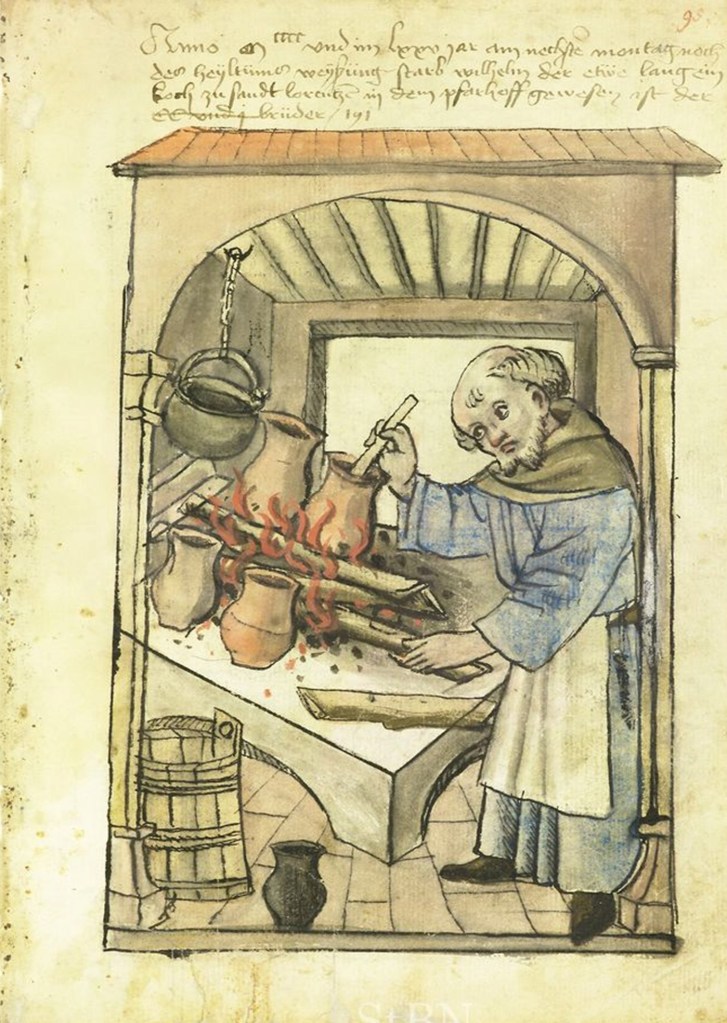
Since around 1425/26, every “Mendel brother” has been depicted in 765 pictures that have been restored and carefully preserved. The pictures show the brothers practicing their craft, with authentic descriptions of the manufacturing processes, tools, workshop equipment, materials, and products. Initially, only the brothers’ names and biographical data were included, but expanded in later centuries to include short biographies.
These pictures from the Middle Ages portray workers from central European towns and cities such as Prague, Krakow, Nuremberg, etc., who traded and learned from their interactions and travels. The ones in this article are from the 1400s.
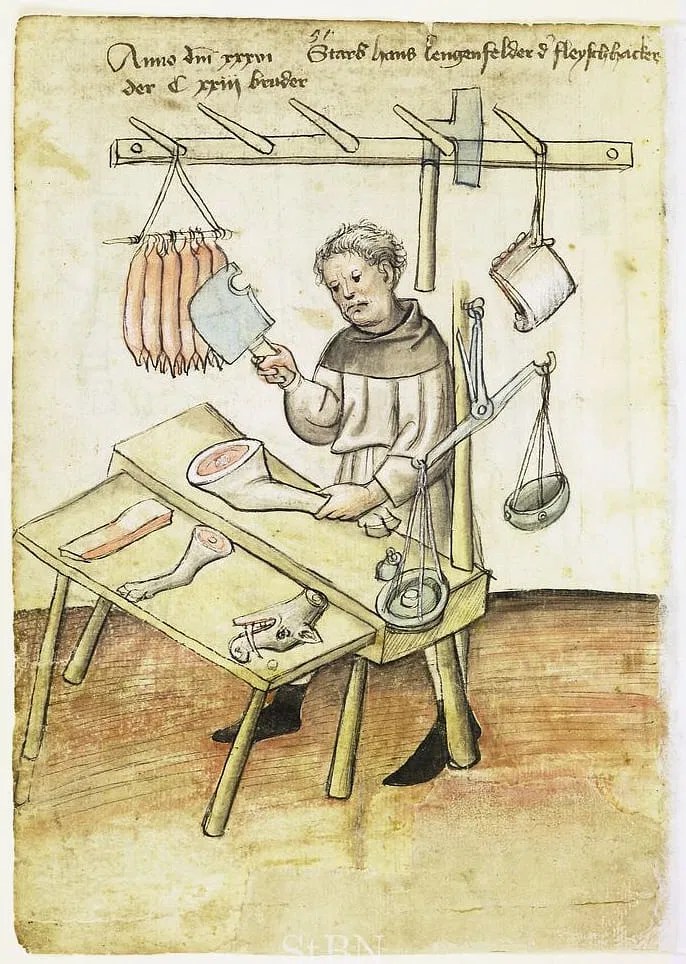
Hans is cutting meat and selling other products, such as sausages. The job of butchering animals created a lot of smell and waste. Towns regulated where they could process the meat.
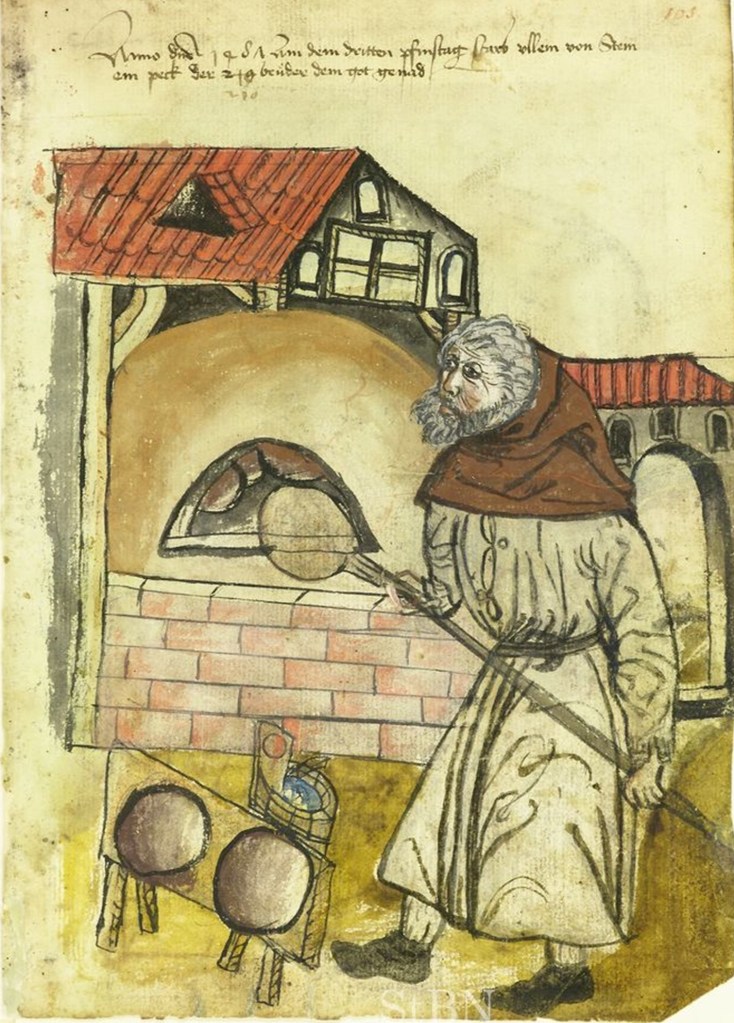
Ulrich, the baker, stands in front of his brick oven and takes out baked loaves of bread with a baking shovel. Below is a pail with water, and two loaves of bread lie on a somewhat unfortunately rendered storage table.
Continue reading Donna Gawell