Poland is well known for scores of fascinating old wooden churches that have survived fires and many wars. Perhaps none is more unique than the little parish church of St. Nicholas in Słopanów in Wielkopolskie. Built around 1695, there may have been an earlier church on or near this site. Historians describe it as a typical post-Gothic wooden church of the Counter-Reformation.
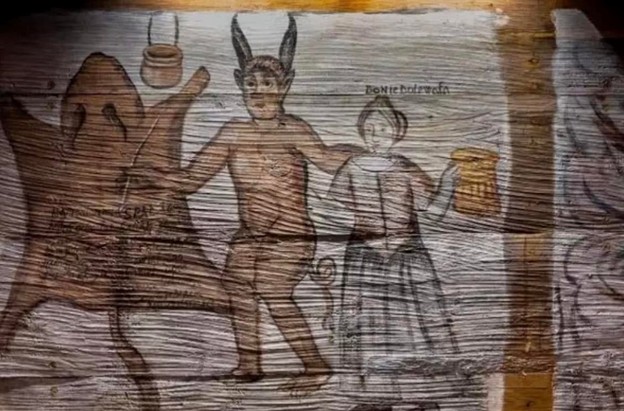
The painting of the devil and his victim is what the church is most known for. The painter was obviously not world-renowned for his talents. Here we see Satan, who looks somewhat like the Easter Bunny, is dragging the innkeeper’s wife to hell. Her sins are listed on a cowhide.
Her first offense is “because she didn’t refill.” Obviously, this was, and still is, a sin truly worthy of being cast into the fires of hell. Any beer fan will confirm this.
But her sins didn’t stop there. They are listed in detail:
Slept (overslept) 120 times
Talked in church 3.000 times
Didn’t pray 220 times
Laughed (inappropriately) 4,000 times
Slandered 500 times
Blasphemed 8,000 times
And earned money through usury, probably collaborating with a guy named Kaczmar
I wondered if the folk artist had his hand in any of the other paintings, which seem more dignified and respectable. I’m guessing he was a “one and done” artist.
St. Nicholas’s story is told throughout the interior through paintings. Nicholas likely lived around the turn of the 3rd and 4th centuries. He was a bishop in the city of Mira, and today he is buried in another Italian city, Bari. Nicholas is considered the patron saint of children.
At the Council of Nicaea, Bishop Nicholas slapped Arius in the face when he became enraged at the man’s heretical teachings. Mostly, St. Nicholas is known for his kindness, which continues today in the legend of Santa Claus. One painting shows St. Nicholas throwing coins into the home of a poor family at night. There’s also the macabre story of an innkeeper who packed three children into a barrel of salt. St. Nicholas saved them.
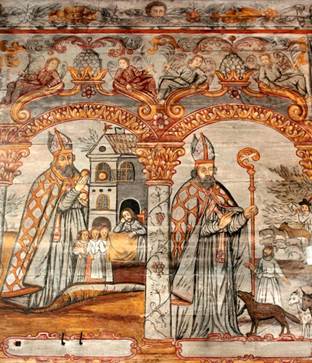
Seven legends of St. Nicholas are depicted in the church. One of the polychromes shows the saint giving three young maidens balls of gold. A poor maiden without a dowry had no chance of marriage. St. Nicholas is shown saving the future of these young women.
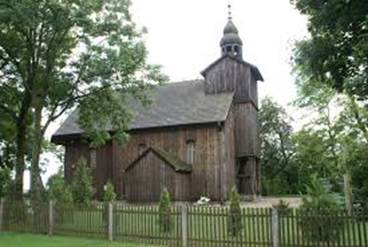
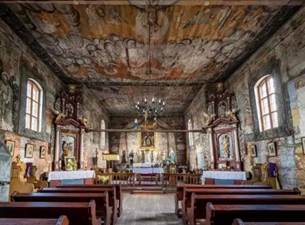
From the outside, the church does not appear particularly distinctive. The inside will amaze you with paintings throughout. This beautiful church was founded by Jan Kasinowski, a Catholic noble and court judge. That painting took four years to complete, and the church was then consecrated in 1699 by Bishop Hieronim Wierzbnowski of Poznań. Between 1699 and 1701, the late Renaissance and Baroque polychrome paintings were added to the church’s interior.
 Donna Gawell