Mehitabel was a “nullius filius” (bastard) child

whip

Mehitabel’s status of a “bastard child”

Mehitabel’s life began poorly with the distinction of being a “bastard child”.  There are a number of legal terms that refer to  this situation more delicately: bar sinister, illegitimate, or “nullius filius”, which means “child of no one”, but Mehitabel was one of the more fortunate children born into this slanderous status. Puritan laws in the new American colonies forced men to take more responsibility for the sin of fornication. Continue reading
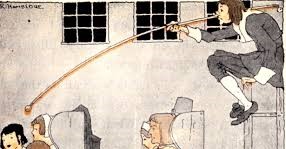
The Tithingman

tithingman-2

The above  image of a tithingman might imply that his job was a cross between a spiritual policeman and a royal fool.  In fact, his position was one of the most important in Puritan New England and went beyond just policing unruly children.

The key responsibility for a tithingman was to keep order in church during the long services conducted in the meeting house or early church buildings.   Most buildings had no heat or fireplace so winter services must have been a challenge.  Stifling hot church services were no reason to keep the congregation at home sitting under the shade of an old oak tree.

Continue reading

Spelling in Colonial times

The writers of court records in Essex County didn’t follow many writing conventions during the early colonial period.  So, we have a variety of spellings found for Richard, Mehitabel, and Joan Braybrooke and Alice Ellis.

Here are some of the variants I uncovered:

Mehitabel, Mehitabell, Mehitable

Joan, Joanne, Joanna

Alice Eliss, Ellis, Eyliss

Braybrooke, Braybrook, Brabrook, Brabrooke, Brabruck

I settled on Mehitabel for the correct spelling as that is how Mehitabel spelled it in a very important letter she signed to the governor of Massachusetts in 1692.

Writers agonize over writing conventions such as spelling and punctuation, but we come to a greater appreciation of them when we struggle with these old documents.


Introducing Mehitabel Braybrooke

Life can begin as a curse. Mehitabel was born in 1652 to Richard Braybrooke and Alice Eliss in Ipswich, Massachusetts.  Joan, Richard’s wife likely wasn’t too pleased when she heard the news, but the town officials found out soon enough!  Richard was whipped severely at the village post for the sin of fornication and Alice was to be whipped when “her travail ended.”  As part of the sentence, the courts ordered Richard to raise his child.  Alice disappears from the town records but Richard,

As part of his punishment, the courts ordered Richard to raise his child.  Alice disappeared from the town records, but Richard, Joan, and Mehitabel are found in many more town entries as the years progress.  Mehitabel was Richard and Joan’s only child.

Mehitabel’s life continues to spiral downward when she finds herself in prison on two different occasions for crimes punishable by hanging.

In the Shadow of Salem, scheduled for release in June 2018 by Heritage Beacon, an imprint of Lighthouse Publishers of the Carolinas, is the first story ever written about this real-life Puritan woman.